Our climate is changing, and our weather is becoming warmer, wetter and wilder. As our climate gets warmer, blacklegged ticks are expanding their range further north, including Burlington. We will likely to see both an increase in the number and variety of ticks, and the diseases they carry.
Vector-borne diseases (diseases spread through insects) can affect everyone’s health. By taking the steps to prepare for ticks, we can make sure everyone has a safe and fun summer.
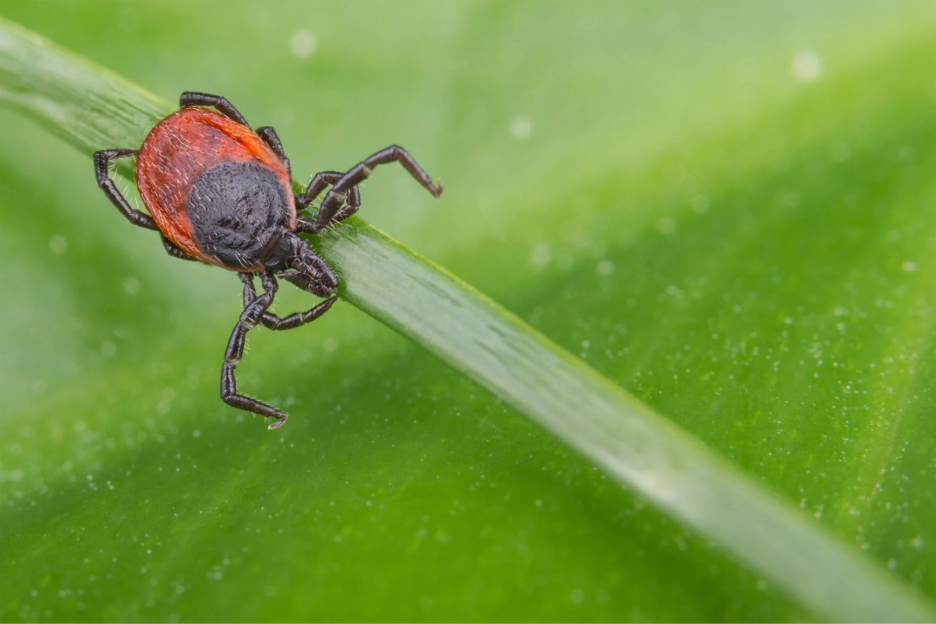
What are Vector-Borne Diseases?
A vector borne disease is a human illness caused by viruses, bacteria or parasites that is transmitted by blood-feeding insects, such as mosquitos, ticks, and fleas.
In Halton Region, one of the most common vector-borne diseases you hear about is Lyme disease, which is a bacterial infection spread by the bite of an infected blacklegged tick (also known as a deer tick). Not all blacklegged ticks carry the bacteria, and not everyone who is bitten by an infected tick will develop signs and symptoms of Lyme disease.
Blacklegged ticks can transmit other diseases such as anaplasmosis, babesiosis, and Powassan virus infection, and the American Dog tick can transmit Rocky Mountain Spotted Fever. The risk of contracting these diseases remains low in Ontario.
Halton Region Public Health conducts biannual tick dragging each spring and fall. Based on this surveillance, all of Halton region is considered an established blacklegged tick risk area. Visit Public Health Ontario’s Vector-Borne Disease Tool for more information on blacklegged tick risk areas
What Does a Blacklegged Tick Look Like?
Adult blacklegged ticks are approximately 0.2 – 0.3 cm in size. They are a reddish brown colour and have a dark spot on their upper back.
Adult American dog ticks are larger, reaching up to 0.5 cm in size. They are brown with an intricately patterned light and dark brown back.
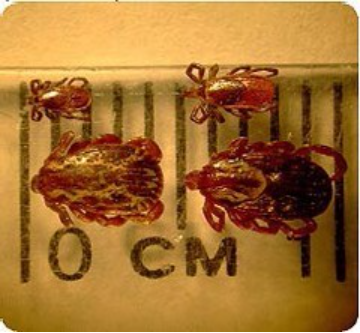
Blacklegged ticks become pale brown to yellow as they start to feed, and dark grey-brown when they are fully fed. As they feed, the tick’s stomach gets bigger, growing to 0.6cm when partially fed, and 1cm when fully fed.
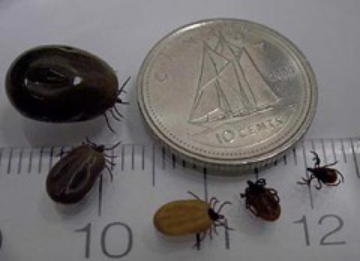
Halton Region Public Health has discontinued the tick submission program. If you have a tick that you would like identified a free on-line tick identification service can provide quick species identification.
How to Prevent Tick Bites
There are several steps you can take to prevent tick bites:
- If possible, avoid known tick environments (such as wooded, brushy or tall grass areas) and stay on trails when outdoors.
- Cover up by wearing long sleeved, light coloured shirts and pants with tightly woven fabric.
- Tuck your shirt into your pants and your pant legs into your socks to keep ticks away from your bare skin.
- Wear shoes that cover your entire foot, avoiding sandals or open shoes.
- Spray clothing and exposed skin with an insect repellent containing DEET or Icaridin.
- Check your clothing and body for any ticks, especially around the groin, armpits and hairline after spending time outdoors.
- After outdoor activity, put clothes in a dryer on high heat for at least 10 minutes to kill any ticks.
- Shower or bathe within two hours or being outdoors to wash away loose ticks.
- Check your pets regularly for ticks as they could carry them inside your home. Just like humans, Lyme disease can affect pets. Check your pet for ticks after being outdoors and if you are concerned contact a veterinarian
Here is how you can reduce the number of blacklegged ticks around your home:
- Remove leaf litter, brush and weeds at the edge of the lawn and around stonewalls and woodpiles.
- Use materials such as gravel, stones, bare soil, cedar chips or sawdust to create a path or border of at least 3-inches around your property.
- Mow the lawn regularly to keep the grass short.
- Put barriers to exclude deer around your home and seal stonewalls and small openings to discourage rodent activity.
- Place children’s playground sets, patios and decks away from the yard edges and trees. Place them on a woodchip or mulch foundation and in a sunny location, if possible.
- Stack firewood neatly and in a dry area.
I’ve Found a Tick on Me: What Should I Do?
If you find a tick on your body, remove it as soon as possible. The risk of getting a vector borne disease varies with the length of time the tick remains attached.
Use clean fine-point tweezers to immediately remove attached ticks:
- Grasp the tick’s head as close to your skin as possible.
- Slowly pull it straight out. Try not to twist or squeeze the tick.
- If parts of the tick’s mouth break off and remain in your skin, remove them with the tweezers.
- If you can’t remove the mouthparts, leave them alone, and let your skin heal.
Wash the bite area with soap and water or alcohol-based sanitizer. Contact your health care provider if you’re not feeling well or if you are concerned after being bitten by a tick. Keep the tick in a closed container and bring it with you if you go see your health care provider.
Signs and Symptoms of Lyme Disease
Halton Region Public Health advises that if a tick is attached to your skin for less than 24 hours, your chance of getting Lyme disease is extremely low. Symptoms of Lyme disease can be different for each person and usually begin within three days to one month after being bitten by an infected tick.
The identification of Lyme disease in its early stages is very important. In most cases, if caught early, Lyme disease can be treated effectively with antibiotics.
Common signs and symptoms of Lyme disease can include any of the following:
- Circular, red rash (often, but not always, looks like a ‘bull’s-eye’), which slowly expands around the tick bite area
- Extreme tiredness and weakness
- Headache and neck stiffness
- Fever or chills
- Swollen lymph nodes
- Muscle spasms, numbness or tingling
More severe symptoms can include:
- Severe headaches
- Facial paralysis
- Joint pain
- Nerve pain
- Heart palpitations or irregular heartbeat
- Dizziness, mental confusion or inability to think clearly, and memory loss
If you were bitten by a tick or experience symptoms consistent with Lyme disease or other tick-borne diseases, contact your doctor or health care provider immediately.
Learn more about Lyme disease and other tick-borne diseases from Halton Region, the Ontario Ministry of Health, and the Public Health Agency of Canada.
Connection to Burlington’s Climate Plans
Did you know that the City of Burlington has three climate plans currently being implemented which address:
- Adapting for our warmer, wetter and wilder weather (Climate Resilient Burlington)
- Reducing emissions from the community with a goal to be net carbon neutral by 2050 (Burlington Climate Plan)
- Reducing emissions from our operations with a goal to be net carbon neutral by 2040 (Corporate Energy and Emissions Management Plan: 2024-2029)
For more information about Burlington’s climate plans, please visit burlington.ca/climatechange.
Take Action Burlington. By being aware of and preparing for the health impacts of our changing climate, we can keep our friends, family and community safe this summer. Collectively we can make a difference.

