Circular Economy Month is a public awareness campaign dedicated to educating and empowering Canadians to support an economy that protects the planet and prioritizes people.
What is a Circular Economy?
A circular economy minimizes waste and makes the most of the earth’s resources by making products that last longer, that can be fixed, reused again and again, and deconstructed into their original parts. In comparison, a linear economy has a “take-make-waste” pathway, where we take the earth’s resources, make them into products, and then dispose of them at their end of life.
“Circularity” means creating products that use fewer materials, last longer, and produce less waste. A circular economy focuses on reusing resources instead of just using them once and throwing them away. It’s a more sustainable system where materials are kept in use for as long as possible.

Learn more at circulareconomymonth.ca
Waste Reduction Week: Oct. 20-26
Waste Reduction Week has been a Canadian education campaign for over 25 years! It started with a focus on recycling education and collection in the mid-1980s and has expanded to promote waste reduction in a variety of sectors including construction, textiles, electronic waste, plastics and food waste
In 2022, the world produced 62 billion kg of electronic waste (e-waste)—the equivalent of 1.55 million trucks. Electronic waste (e-waste) includes unwanted, broken or old electronic equipment, such as smart devices and used cables, as well as batteries and fluorescent lights. Many of the parts that make up your electronics, such as steel, glass, copper, aluminum, plastics and precious metals, can be recovered and made into new products – so long as they are properly recycled.
Lithium-ion Battery Fires are on the Rise: Help Bend the Trend
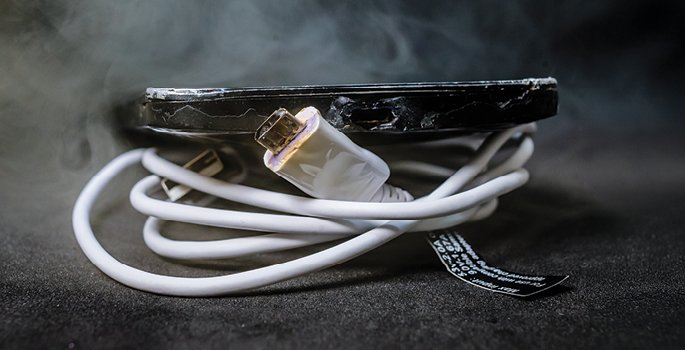
While rechargeable battery devices have brought convenience to our lives, they also come with fire risk, especially when damaged or improperly used and disposed of. As this trend of lithium-ion battery fire incidents continues, Burlington Fire Department officials, along with other provincial and national fire services, are asking for YOUR help. Lithium-ion batteries are found in your rechargeable battery devices, like smartphones, laptops, e-bikes, power tools, and vapes. These batteries store a big amount of energy in a small space. So, when they are overcharged, short-circuited, punctured, or exposed to heat, they can catch fire or even explode releasing toxic fumes. These fires are very difficult for firefighters to extinguish as they tend to spread quickly.
You can minimize the risk of lithium-ion battery fire by:
- Buying batteries and chargers from trusted retailers. Avoid cheap or unbranded batteries and chargers sold online or through unofficial channels.
- Looking for product safety certifications.
- Always using chargers and batteries designed and made for the device and/or recommended by the product manufacturer.
- Avoiding charging batteries on beds, couches, pillows or near flammable materials.
- Checking for damage. If a battery looks swollen, leaks, or emits a strange odour or sound, stop using it immediately.
- Disposing at an approved facility or event.
- Keeping batteries away from direct sunlight, heaters, water and freezing conditions.
Learn more about lithium-ion battery safety and watch the Burlington Fire Department’s video Join the Charge Against Battery Fires.
Local Recycling and Disposal
You can do your part for Circular Economy Month and Waste Reduction Week by properly disposing and recycling your household waste. Halton’s household waste goes to the Halton Waste Management Site, (5400 Regional Rd 25, Milton). Residential household hazardous waste can also be dropped off for free at the site.
Not sure where your item goes? Use Halton Region’s “Put Waste In Its Place” online tool to type in the name of your item and learn how to dispose of it properly. By typing ‘batteries’ you will see that there are many locations in Burlington, such as community centres and pools, where batteries are accepted. Halton Region also hosts Special Waste Drop- off Days throughout the year across Halton.
Community drop-off bins for undamaged electronic waste recycling are available at Fire Station 4 (711 Appleby Line, Burlington) and Fire Station 7 (4100 Dundas St., Burlington) and support Burlington’s vehicle rescue team.
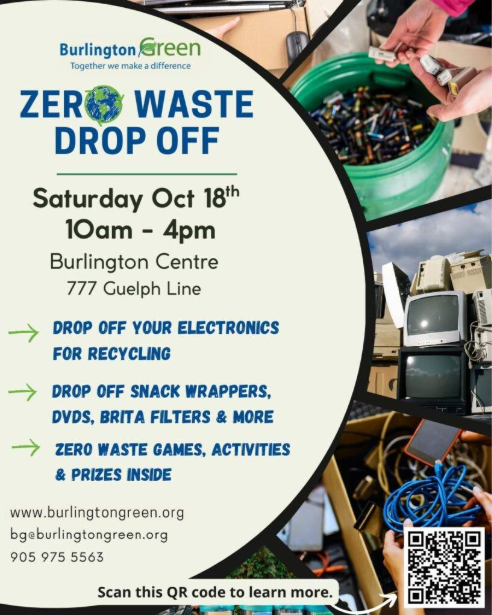
Zero Waste Drop Off Event
- Saturday, Oct. 18 from 10 a.m. to 4 p.m.
- Burlington Centre – 777 Guelph Line.
Drop off your lithium-ion batteries and electronic devices for convenient, responsible recycling at the Burlington Centre’s parking lot on the corner of Guelph Line and Fairview. This event is held in partnership with BurlingtonGreen, Burlington Centre, Tech Genius Burlington Inc., and the Burlington Fire Department
For more information
For more information and resources, visit: Charged for Life
Take Action Burlington! By choosing safety-certified products and following safe handling practices, consumers can significantly reduce the risk of lithium-ion battery fires. Awareness and a fire-safe attitude go a long way in keeping your devices – and your home – safe. Collectively we can make a difference.
This post was authored in partnership with the Burlington Fire Department’s Public Education Officer .
 Take Action Burlington