
Did you know that flooding is the most common natural disaster in Canada? Unfortunately, the City of Burlington has experienced two major floods in recent years: in August 2014 where over 3,000 households reported flooding, and July 2024 where over 1,500 households reported flooding.
Warmer, wetter and wilder weather associated with climate change is increasing the chance and severity of flooding. Since 2014, the City has promoted steps you can take to protect your home and property against potential flood damage before a flood happens. Don’t forget to also prepare a household emergency plan in the event of a severe flood.
Flood Related Programs Offered by the City of Burlington and Halton Region
Home Flood Protection Program
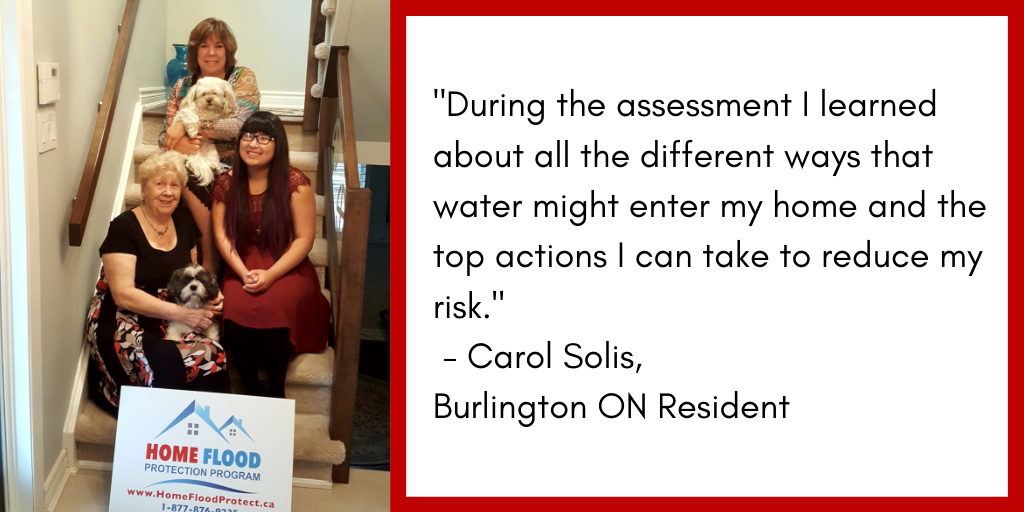
Launched on the third anniversary of the Burlington flood of 2014, the City of Burlington offers the Home Flood Protection Program to help homeowners reduce their risk of basement flooding and minimize damage if flooding occurs. Eligible homeowners receive up to 50 per cent of the cost of an in-person or remote assessment. Over 130 assessments have been carried out since the program began with up to 20 subsidized assessments available each year.
Plumbing Permit Fee Grant Program
Since the 2014 flood, the City of Burlington has offered a Plumbing Permit Fee Grant Program covering the cost of a building permit associated with specific improvements done in homes or businesses to reduce the risk of basement flooding. These include the installation of backwater valves, disconnection of foundation drains from the sewer system, and the installation of sump pumps. Over 1,000 permit fee grants have been issued through this program since 2014 with 59 grants issued in 2023.
Halton Region’s Enhanced Basement Flooding Prevention Subsidy Program

Halton Region’s Enhanced Basement Flooding Prevention Subsidy Program offers financial support for residents who make improvements that can help reduce the risk of flooding. Available subsidies include downspout disconnection, backwater valve installation, sewer lateral (pipe) linking and repair, and weeping tile disconnection and sump pump installation. Subsidies range from 50 to 100 per cent of the cost of the work up to a maximum dollar value which varies for each program. Since 2014, over 1,300 subsidies have been provided to Burlington residents through this program.
Preparing for Warmer, Wetter and Wilder Weather
Everyone has a role to play in emergency preparedness. By doing a few basic things to prepare yourself, your family and your home/business for a flood, you can help reduce your risk of basement flooding and minimize damage if flooding occurs.
Here are some things you can do: Before Flooding
Participate in flood related program(s)
- Register for one or more of the programs mentioned above relating to flooding where applicable.
Make your home flood-ready
- The Government of Canada provides 10 tips to make your home flood-ready and other online resources that help prevent overland flooding in your home.
- The Intact Centre on Climate Adaptation at the University of Waterloo offers similar resources: Three steps to cost-effective home flood protection and key flood resilience measures for commercial real estate in Canada.
Create an emergency kit
- Households are recommended to have a home emergency kit as well as a vehicle emergency kit. For a list of things to include in your home and vehicle emergency kit, visit: burlington.ca/emergencyprep.
Register for flood messages
- Sign up to receive flood messages from Conservation Halton here.
Prepare your home
You can take the following steps to minimize flood related damage:
When Conservation Halton has issued a flood watch for Burlington, which means flooding is possible:
- Make sure all basement windows are closed.
- Move furniture, electrical appliances and other belongings from the basement to higher levels.
When Conservation Halton has issued a flood warning for Burlington, which means flooding will happen or already occurring, and you observe floodwaters approaching your home:
- Turn off your basement furnace and outside gas valve.
- Turn power off to circuit breaker or fuse box.
Here are some things you can do: During Flooding
Follow instructions from local authorities
- When advised to evacuate, immediately leave your home with your family/household members and pets and go to the designated Evacuation or Reception Centre, bringing your emergency kit.
Protect yourself on the road
- Follow the recommended evacuation routes, as directed by police. Respect road closures and never take shortcuts as other roads may be flooded.
- If you come across a flooded road, take a different route, as it can be hard to know how deep the water is, and as little as 30 cm can carry a vehicle away.
- If the road you are travelling on begins flooding, immediately leave your vehicle and take yourself and your passengers to higher ground, without crossing floodwaters. As little as 15 cm of floodwaters can sweep you off your feet.
Get updates
- Emergency information will be shared in various platforms, including the City’s website and social media channels.
- You can also listen to local radio stations and television channels for updates.
Here are some things you can do: After Flooding

Use extreme caution when returning to your home after a flood. Restore your home to good order as soon as possible to protect your health and prevent further damage to the house and its contents (ideally within 48 hours). The Government of Canada and Halton Region provide detailed guidance on flood clean-up procedures.
Do not return home until authorities have advised that it is safe to do so.
- If the main power switch was not turned off prior to flooding, do not re-enter your home until a qualified electrician has determined it is safe to do so.
- Appliances that may have been flooded pose a risk of shock or fire when turned on.
If you have a private well:
- Don’t turn on the well pump because there is a risk of electrical shock.
- Hire a certified well contractor to inspect your well and its wiring before use.
- Don’t use your well water until you get advice from your local health authority on clean-up, well disinfection, and water testing to make sure your water is safe to use.
Take Action Burlington! Prepare for our warmer, wetter and wilder weather. Collectively, we can make a difference.
 Take Action Burlington